Profile
-
Full Name:唄三線 utasanshinAbout:About utasanshin
utasanshin is traditional singing (uta) and playing of the sanshin, a three-stringed lute that originated in Mongolia or China and is still played in those cultures as well as in Vietnam and the Ryūkyū Islands, of which Okinawa is a part. The sanshin was later imported from Ryūkyū to Japan, where it was transformed into the shamisen. On the Ryūkyū Islands, utasanshin is practiced at all kinds of recreational activities and formal occasions, often also together with drums. Two main streams of the tradition–the royal Ryūkyū court on one side and the common people on the other–as well as regional differences have resulted in different styles.
About me
In Okinawa, where I live, everyone calls me Ema. As a young child in the Swiss mountains and then in rural Japan, I was exposed to the respective folk tunes based on natural tonal systems. These form musical reference systems, deeply imprinted in me. I study, play and teach different Asian musics and dances in different places since 2013. Ryūkyūan and Persian music is my main focus now, after practicing Korean and Japanese music for years.
My teacher for Ryūkyūan Folk Songs is Kōichi Kamiya, the president of the Ryūkyūkoku Folk Song Association.
I speak Japanese, English, German, French, Italian and to a certain degree Korean. I am learning Uchinaaguchi, the Ryūkyūan language. I have also an engineering background, which, together with my language skills, allows me to make Ryūkyūan music known to an international audience. In doing so, I give all my best to follow the UNESCO Recommendations on Open Science.
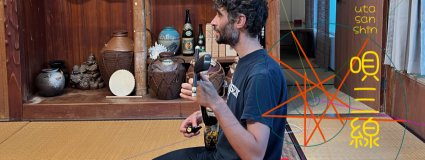

唄三線 utasanshin
utasanshin@utasansh.in
三線を弾きながら、琉球の唄を唄おう!Let's sing Ryūkyūan songs while playing sanshin!