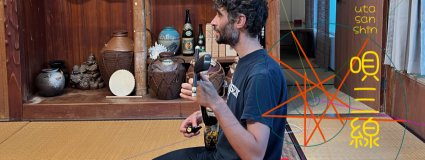
How do you learn the tonal system and the method of tuning the instrument?
| A detailed illustrative step-by-step approach will be presented in this document: |
|---|
Tuner? Notation? No thanks—I can do better without them!(a proper download link to the English version will be provided soon) |
チューナー?結構、要らないよ!(the Japanese version is in progress) |
Here is a summary of the thoughts which made me write the document:
Ancient knowledge We are fortunate to find simple concepts and associated nomenclatures in the Chinese cultural sphere, which includes Vietnam, the Ryūkyūan islands, Korea and Japan, and in the Greater Persian cultural sphere, which has some things in common with the Arabic cultural sphere in the area of music. Such easily digestible and at the same time ingenious concepts can be used to illustrate what we do in music in a simple way. |
Nature helps us We tune the sanshin without a tuner. The method, which is at least 2600 years old and was documented at about the same time in the Chinese and Hellenistic empires, is very simple because it requires only two harmonic intervals. And already we have arrived at the concept of interval, the "distance" that lies between two tones. When learning traditional music, the intervals are sung and played on the instrument, training the hearing. This training is essential for everybody who is singing or playing traditional music: We need to have been exposed to these intervals to a sufficient degree and have been able to practise them repeatedly. Fortunately, the two intervals mentioned above follow the physical law of harmony and are therefore very easy to recognise by hearing. They are also the most easily recognisable intervals when two tones are played simultaneously, because the strings then resonate strongly to each other. By using these intervals in a sequence, we tune the instrument and at the same time generate a tonal system in which four other harmonic intervals appear. The tonal system thus obtained is used not only in China but can serve as a base framework for Ryūkyūan, Korean, Japanese, Persian, Arab and many other musics as well. |
Characteristic regional pecularities: non-harmonic intervals However, as in Persian, Javanese, Korean etc. music, also non-harmonic intervals can be found in Ryūkyūan music, which may vary slightly from region to region and sometimes from teacher to teacher. The Ryūkyū Kingdom, which shaped Ryūkyūan culture, was very active in trade between the South China Sea (China, Java, Siam, Malacca, Philippines etc.) and Korea / Japan. Cultural exchange with these regions took place. Some of these regions in turn were in exchange with Persian and later Arab culture via the Silk Road as well as via the trade routes in the Indian Ocean. It is possible that the non-harmonic intervals found their way to the Ryūkyū Islands from the musical traditions of these regions or even from Persia, maybe together with the arrival of the rebâb, which became the kuuchoo (a fiddle used in Ryūkyūan music which is very similar to the sanshin). The court music of Central Java, for example, is strikingly similar to Ryūkyūan, while still being different. Such regional characteristics and presumed connections between them can easily be explored on the sanshin by looking at different traditional songs. Through such explorative practice and by listening to representative recordings, interested students learn to reproduce the six harmonic intervals as well as the Ryūkyūan (and maybe other regional) non-harmonic intervals, which are, just like the harmonic ones, different from those found on a standard Western (12ET) tuned piano or guitar. |
Figurative nomenclature I use the Persian names for the intervals that occur, because they are descriptive and therefore easy to remember. They mean, for example, "time", "the predominant", "part", "the reverberating", "remnant", etc. Thanks to the appropriate meanings, they can be easily associated with the respective interval. I only mention the corresponding Western names, e.g. "perfect fifth" or "Pythagorean minor third", if my students have a background in Western music theory and explicitly wish them to be mentioned. These Western names correspond to a numbering system, to which the concept of a scale is subject (but the numbers don't follow the order of the scale). However, since Eastern music is based on a concept of intervals rather than scales, the use of Western names is not appropriate and especially not helpful for those who are not familiar with them. The tones and pitch classes themselves are also named, favourably relative and independent of an instrument or a tuning. I use the Chinese names for the five main pitch classes and the four secondary ones, each of which has its own unique position in the (relative) tonal system described above. I extended the Chinese nomenclature for the pitch classes which make use of non-natural intervals. The Chinese names have memorable and appropriate meanings such as "palace", "merchant", "corner", "omen" etc. and are more suited than the Western solmisation which has no figurative meanings. While a translation of Chinese nomenclature, which is relative, into solmisation (do, re, mi, etc.) is possible if the latter is understood as relative rather than absolute, I strongly advise against using solmisation or even the absolute pitch names C, D, E, etc., as they most likely cause confusion since they normally bring to mind the 12-tone chromatic scale, into which traditional Eastern music doesn't fit at all. I can imagine that the nomenclature proposed by me could be of great use also for teaching or learning Persian dastgâh music, for which unfortunately French solmisation (which is absolute and causing a lot of confusion between dastgâh scolars) is widely used. We also use the Chinese names of the five main pitch classes to name the modes that arise when a tone of the main pitch classes is used as the fundamental: For example, we have the "palace mode", which is "clear", "elegant" or "festive" depending on the choice of secondary pitch classes. A traditional song is in one of these modes, often expanded with the peculiar regional non-harmonic pitch classes. |
Three tunings for the sanshin In order for a mode to be played particularly well, the instrument is sometimes retuned. We know three tunings for the sanshin. It is fundamental to understand how they are characterized and how to switch between them. |
Finger positions People on the Ryūkyū Islands sometimes name the finger positions on the instrument. As long as the tuning doesn't change, a finger position keeps corresponding to a certain tone within the tonal system (except when switching between songs in the Ryūkyūan and the Japanese modes). Just remember that if the tuning of the instrument changes, that same finger position might no longer correspond to the same tone. When distinguishing between the Ryūkyūan and the Japanese and between the harmonic and the non-harmonic tones, at least thirty-six finger positions are found on the sanshin. |
Learning by observing and listening In practice, we can easily do without knowing the names for finger positions, or even for intervals and pitch classes, because the traditional teaching method for utasanshin is miinari chichinari (learning by observing and listening). Also, notation is not used. The songs are understood with the heart in the end. |