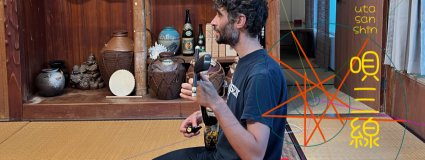
| Utasanshin, the practice of singing traditional Ryūkyūan songs while playing the sanshin, is the core of Han Ema's musical endeavours. Please contact utasanshin@utasansh.in for any enquiries. |
Login
Photo Albums
唄三線 utasanshin
utasanshin@utasansh.in
三線を弾きながら、琉球民謡を唄おう!Let's sing Ryūkyūan folk songs while playing sanshin!
About utasanshin utasanshin is traditional singing (uta) and playing of the sanshin, a three-stringed lute that originated in Mongolia or China and is still played in those cultures as well as in Vietnam and the Ryūkyū Islands, of which Okinawa is a part. The sanshin was later imported from Ryūkyū to Japan, where it was transformed into the shamisen. On the Ryūkyū Islands, utasanshin is practiced at all kinds of recreational activities and formal occasions, often also together with drums. Two main streams of the tradition–the royal Ryūkyū court on one side and the common people on the other–as well as regional differences have resulted in different styles. |
About me In Okinawa, where I live, everyone calls me Ema. As a young child in the Swiss mountains and then in rural Japan, I was exposed to the respective folk tunes based on natural tonal systems. These form musical reference systems, deeply imprinted in me. I study, play and teach different Asian musics and dances in different places since 2013. Ryūkyūan and Persian music is my main focus now, after practicing Korean and Japanese music for years. My teacher for Ryūkyūan Folk Songs is Kōichi Kamiya, the president of the Ryūkyūkoku Folk Song Association. My teacher for the radif for santur in Persian dastgâh music is Hassan Tabar. I speak Japanese, English, German, French, Italian and to a certain degree Korean. I am learning Uchinaaguchi, the Ryūkyūan language. I have also an engineering background. |
What previous knowledge do you need to bring for practicing utasanshin? None. Within the world of music, utasanshin is probably the least difficult thing you can do. This starts with the fact that the sound of the instrument is of great support for singing. The tones played on the sanshin also resonate very strongly to each other (due to the fact that the saddle is placed on a stretched skin)–which makes the musician training his hearing and adjusting the tones on the fly to become in tune. In addition to that, utasanshin is not something that you can only practice if you understand a certain complicated theory or if you know how to read musical notation–the contrary is the case. It is taught actually without using musical notation, but with a teaching method called miinari chichinari which means "learning by observing and listening". This fits with my aspiration to musical teaching that it must not be selective in terms of intelligence or previous education. Social inclusion is a principle with me. But that's not the main reason why I spread my knowledge about traditional Eastern music without making use of Western music theory, which I find both unintuitive and hard to understand. Traumatized by today's institutionalized Western music instruction, which presupposes an understanding of Western music theory, many of my friends believe they are unmusical. The main reason for not making use of Western music theory is that it hinders understanding Eastern music because it doesn't do justice to what's important in Eastern music. So, no worries if you think you're unmusical–that's the perfect prerequisites to start with utasanshin! |
How I spread my knowledge My language skills as well as my experience in teaching allow me to make Ryūkyūan music known to an international audience. In doing so, I give all my best to follow the UNESCO Recommendation on Open Science. I can show you how to make use of the physical properties of natural pure intervals to sing and play the correct pitches—knowledge that is useful for all types of folk music around the world. I can give an introduction to minyo (folk song) singing technique, which is–among other things–about how you make use of your breath. Building on this foundation, you will be able to work first on simple and later on advanced folk songs from the Ryūkyūan Islands. You will be able to practice traditional musics without resorting to industrial technology. We make do with singing and handmade instruments and do without a tuner. We don't use notation. I can show you how to memorize traditional musical pieces by observing and listening, then imitating and repeating them, and by clarifying the meaning of the lyrics and the cultural context (rituals, etc.). For those interested, some Eastern (ancient Chinese and Persian) music theory can be helpful, especially when it comes to tuning the sanshin, or when a student has trouble leaving behind a learned Western understanding of music and trying something new. But those who are intuitively inclined would easily understand even my theoretical remarks with their "ears" or with their "body" - the analytical "headwork" can be omitted. You can request online seminars, individual classes or join an ongoing online group training. Please make your request via utasanshin@utasansh.in. |
How can you get your own instrument? Acquiring a sanshin which is both inexpensive and of good quality and getting it shipped to your location without damaging it is possible. I can give you some advice. |

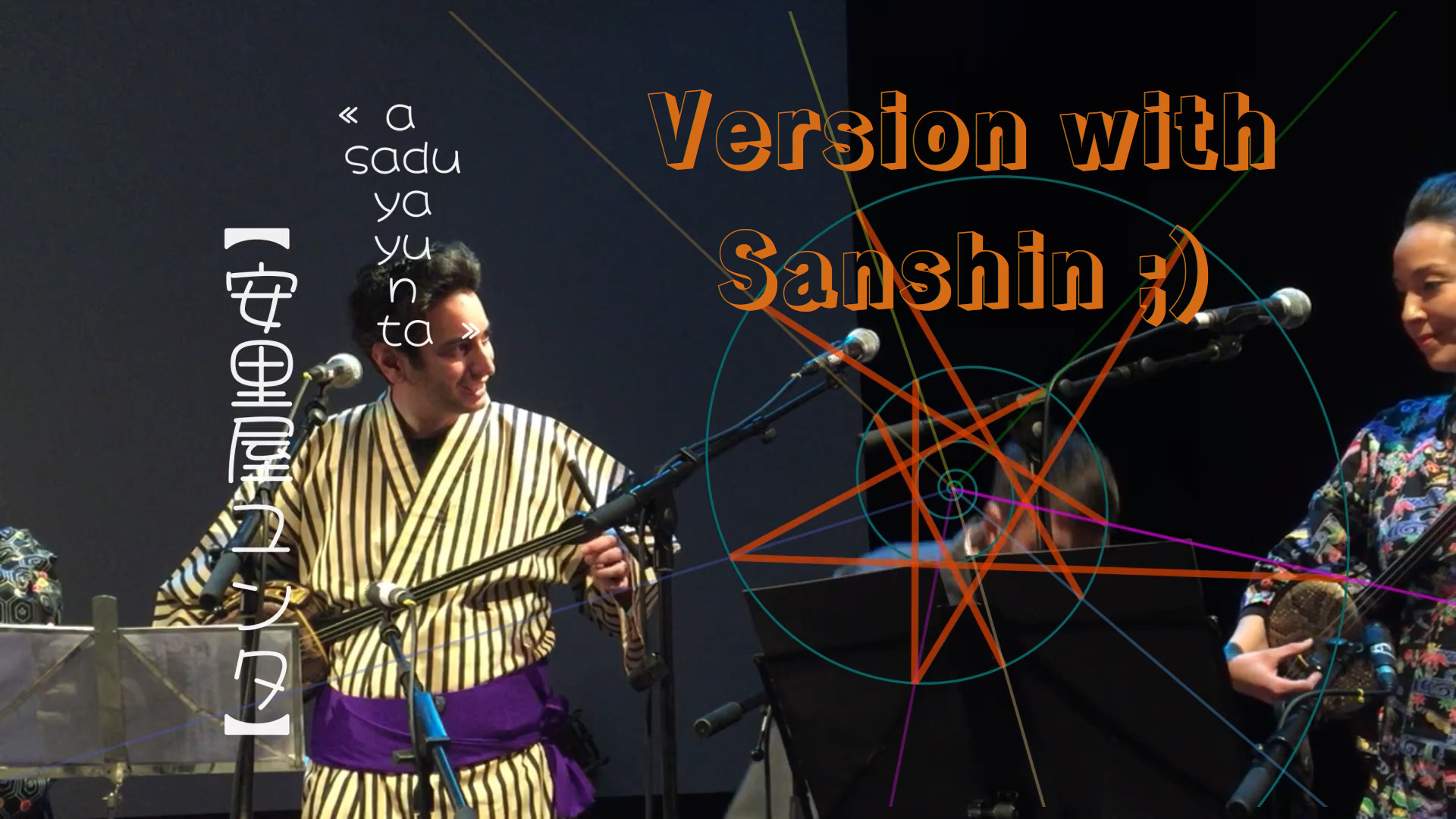
Our very first time to sing and play in front of an audience.
The lyrics to Asadoya Yunta originated from a story where a beautiful lady from Taketomi Island, known as Asato Kuyama (安里クヤマ) (1722-1799), received a wedding proposal from a Ryukyuan government official who came from another island. In one version of the story, the woman bravely rejects the proposal as she felt as if marrying a local man from her island would provide a better life than to become a mistress of this official. In another version, Kuyama ends up marrying him.