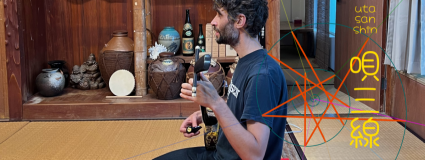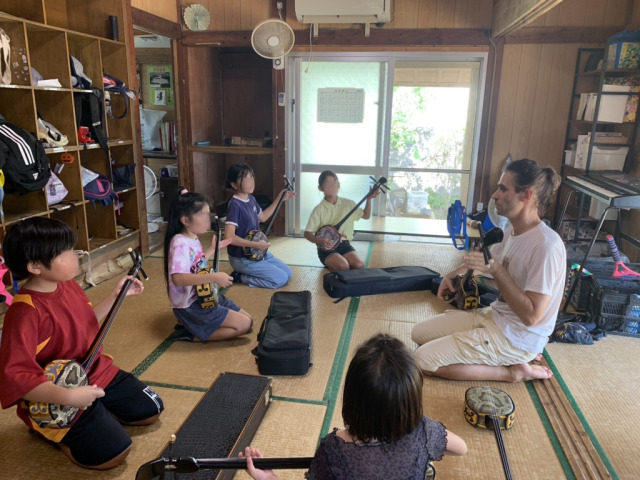
What previous knowledge do you need to bring for practicing 'utasanshin?
None. Within the world of music,
#utasanshin is probably the least difficult thing you can do. This starts with the fact that the sound of the instrument is of great support for singing. The tones played on the
sanshin also resonate very strongly to each other (due to the fact that the saddle is placed on a stretched skin)–which makes the musician training his hearing and adjusting the tones on the fly to become in tune.
In addition to that,
utasanshin is not something that you can only practice if you understand a certain complicated theory or if you know how to read musical notation–the contrary is the case. It is taught actually without using musical notation, but with a teaching method called
miinari chichinari which means "learning by observing and listening". This fits with my aspiration to musical teaching that it must not be selective in terms of intelligence or previous education. Social inclusion is a principle with me. But that's not the main reason why I spread my knowledge about traditional Eastern music without making use of Western music theory, which I find both unintuitive and hard to understand. Traumatized by today's institutionalized Western music instruction, which presupposes an understanding of Western music theory, many of my friends believe they are unmusical. The main reason for not making use of Western music theory is that it hinders understanding Eastern music because it doesn't do justice to what's important in Eastern music. So, no worries if you think you're unmusical–that's the perfect prerequisites to start with
'utasanshin!